Thursday, September 28, 2017

Week 6 Story planning: Combining Sherlock and the Mahabharata

File:Sixn-03.jpg
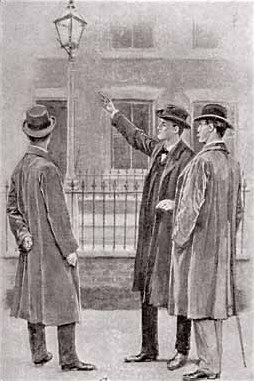
An image of Sherlock Holmes. Source

I was reading the story of King Shantanu and Ganga (by Donald A. Mackenzie) and I was really interested in the basis of the story. When all the extraneous elements are stripped away from it it is the story of a person not understanding why someone they trust is doing something seemingly awful. The character of course later learns that his partner had a very good motivation for doing this.

The story from the Mahabharata we read had a wife throwing her babies into the river despite her husband's confusion. As this is an Indian epic we as an audience know from the beginning the reason, but the king husband does not.

I like the base concept so I was trying to think of a new way to present the story, while still havig the same core backbone of a trust issue breaking two people apart. While I was thinking somehow a Sherlock Holmes short story came to mind, The adventure of the six napoleons.

Basically in this story, a thief has hid his jewel in one of six busts of napoleon before he was locked up. He got out and now must find the jewel. He doesn't know which napoleon bust it is in and he must find the bust's new owners. Meanwhile Sherlock has no idea why people's busts are being broken and neither does the audience.

I want to combine the stories by taking the trust element from King Shantanu and the jewel hiding in pottery element from the Sherlock story in order to create a fairly interesting original story. One major element I will change is to have the audience not find out about the twist until the main character does, to add more suspense.

This is the kind of story I could adapt into one of my short films, hence why I wanted to take another week to plan it out.


Wednesday, September 27, 2017

Reading notes: Mahabharata part B

Well the first story already has a problematic reading that it is perfectly OK to burn up some lower caste people as long as they aren't the princes...


Reading Source:

It's interesting some of the structural similarities between this story and the previous book we read. Just as Rama had to exile himself to the forests so to do the pandavas.

Huh, so apparently Rakshasi can be not all that bad. Today I learned. I'll definitely use this in one of my stories.

So Brihma just appears whenever he is needed? That's actually quite cool.

The concept of a sacrificial ritual having to be performed to bring about the birth of a child is very poetic in nature.

I don't fully understand why the Pandava must hide if they are more powerful than their enemies.

I think its kinda hilarious that they are switching up the gender numbers in the Pandavas somewhat mistaken marriage.

How did any of them think that this marriage was going to work!

I like the second telling of Arjuna and CHita better because it is a bit more humorous.

I kinda thought they were going to find a way out of the whole five husbands one wife thing but I guess that's just here to stay, huh?

This story is so much more political than the previous tale. i wonder if that has something to do with it supposedly being originally told by a monarch.

Hold on a second while I look up what Parcheesi is....


Tuesday, September 26, 2017

Reading notes: Mahabharata

Link to reading


The first story already is promising that this new reading is going to be even more out there than the last one and that I'd saying something!

I'm not going to lie, I just got comfortable with the names from the previous reading and now... There are even more.

The part about Satyavati becoming a virgin again is by far one if the strangest things I've read in a while.

Brishma's vow is strange and apparently motivated only out of live for his father, but I don't see how it is terrible.

Brishma is pretty much just a servant to his family at this point.

Amba is going to reincarnate as a dude just to kill Brishma? This story grows in wildness.

Ambika's blind child and how she got it is kinda hilarious.

I feel like panda giving up everything but his wives is the exact opposite thing that he needs to do to overcome his curse.

So snake poison is a cure for poisoning. Huh...

What is the moral of the story of the bril archer? It seems like a not good one.

I find it strange that a teacher can demand anything of his pupils.

Thursday, September 21, 2017

Week 5 Story: The mighty and the flea

Backstory is just as important, if not more so, as fore-story. It is important to understand where one is before one might understand where they must go. Moving blind through life is a recipe for disaster and strife, but onto our story at hand.
There once was a man, so strong and so powerful that none dared face his might. He could slay monsters and demons with a single arrow from his epic bow. His wife was considered the most beautiful in the land. Her beauty could make a saint repent or a monk speak tongues.

Well this man, despite his infinite charm and in-spite of his power bred many a jealous enemy. But there was one rival that could light a candle to the strength of the man. He envied the strength of the man, he envied his beautiful wife, he envied the respect that he was awarded world wide.

And so, one day this rival hatched a plan, and indeed he executed his evil will. The rival stole the wife away. He took her to the most safe guarded of castles, a fortress impenetrable to even the man himself.The fortress was built of bricks so tightly that no arrow could possibly penetrate their exterior. And so, the man was without his Wife.

The man was in sorrow, for he knew not if his wife was alive or dead. Soon, news of his tragedy spread far and wide. Creatures great and small heard the tears shed by the mightiest of men.

Many came to the aid of the man. But alas, one by one they all tried and failed to penetrate the walls of the fortress.

Finally after many months the man gave up hope. But in this moment of utter defeat a hero emerged. It was not a lion, with a roar to shatter bones. It was not a bear, with arms to do much the same. It was a flea, a simple, small flea.

This flea though was able to do what no one else could. He was tiny enough to slip through the brick and mortar and make his way into the fortress, there he saw that indeed the wife was still alive, and fighting fiercely to stay away from the rival.

The man's vigor was renewed.

Now that is the end of this story. But stories never really end, just as they never truly begin.

Author's notes: I based this story off of the tale where Hanuman is able to sneak into the castle to see if Sita is alive. I changed the story to focus on the mighty Rama having one weakness, one that he could not get past without the help of his friend Hanuman.

Wednesday, September 20, 2017

Reading notes: Animated Ramayana movie part 1


I am perplexed by the animation style that the creators chose to use, but its definitely unique at the very least. Either way it is a bit grating how it is constantly switching up. It's actually quite interesting that here I find it quite useful that Rama has Blue skin. No matter the art style, Rama is very easy to find among the other characters. I wonder somewhat if this is why he was given blue skin in the original legends, to make him easily stand out in a variety of paintings done by various artists. it is an interesting bit of character design that I at least hadn't thought about until just now.

The story telling style is also a bit interesting. i feel somewhat that the interludes by "narrators" are just there to hold audience attention while the story dulls down a bit, but to me they distracted from the overall story too much. I also didn't fully understand the framing device the story was using. i couldn't tell what was narrative and what was meta-narrative.

I find it really interesting that the animated story decided to cut right to the chase and have Rama almost immediately expelled from the city and then further cut right to Sita's kidnapping, it makes for a more cohesive narrative I think. Cutting out the brother entirely though I feel may have been a decision that ends up hurting the impact of the narrative in the long run though. The music is also cool. It allows for a romance that was missing in the writings to appear.

Still though it is a charming portrayal of the Ramayana and I can;t wait to see the second half this weekend.

Tuesday, September 19, 2017

Reading notes: Ramayana D


PDE Ramayana:
I'm a little late on this one, but it has been a busy week.

I like how Rama found a very... obvious loophole to the "unfordable " river. It feels like someone else might have thought of this.

Ravana did not do a very good job of tricking Sita. He kinda gave up really early.

I'm not going to lie, I kinda forgot Rama was leading an army of monkeys. Rally makes this super serious battle have a bit of a humorous tone in my mind.

Kumbhakarna is kinda humorous, especially since he required food before he could fight.

I don't know why, but I really like Hanuman, maybe its just his name. That might be a stupid reason but it makes me think about the importance of character names.

This battle with Ravana is definitely the most epic battle of the entire epic so far and I'm definitely curious to see how it ends.

Even the demons believe it is evil to kill women. That is actually shocking.

Lakshmana I think should have died here as far as storytelling goes, it shows that Rama had to lose something in order to regain Sita, but as is, it doesn't look like that will be the case.

The gods high key cheat by sending Rama help. They can't just force their prophecies to come true, can they?

I like how Agastya comes back, if only for a little bit. It's nice to have some repeating characters.

So Rama completed his destiny. I wonder what is left for him.

Rama not taking back Sita is not a good ending to this story, maybe culturaly, yes. But I'm salty.

Nevermind, he takes her back.. sorta, all is well.